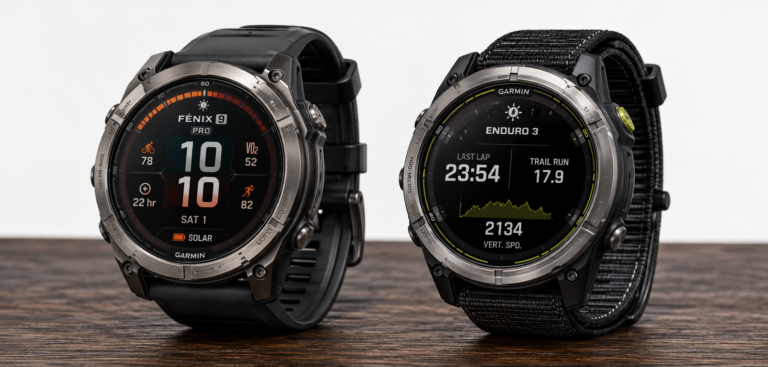
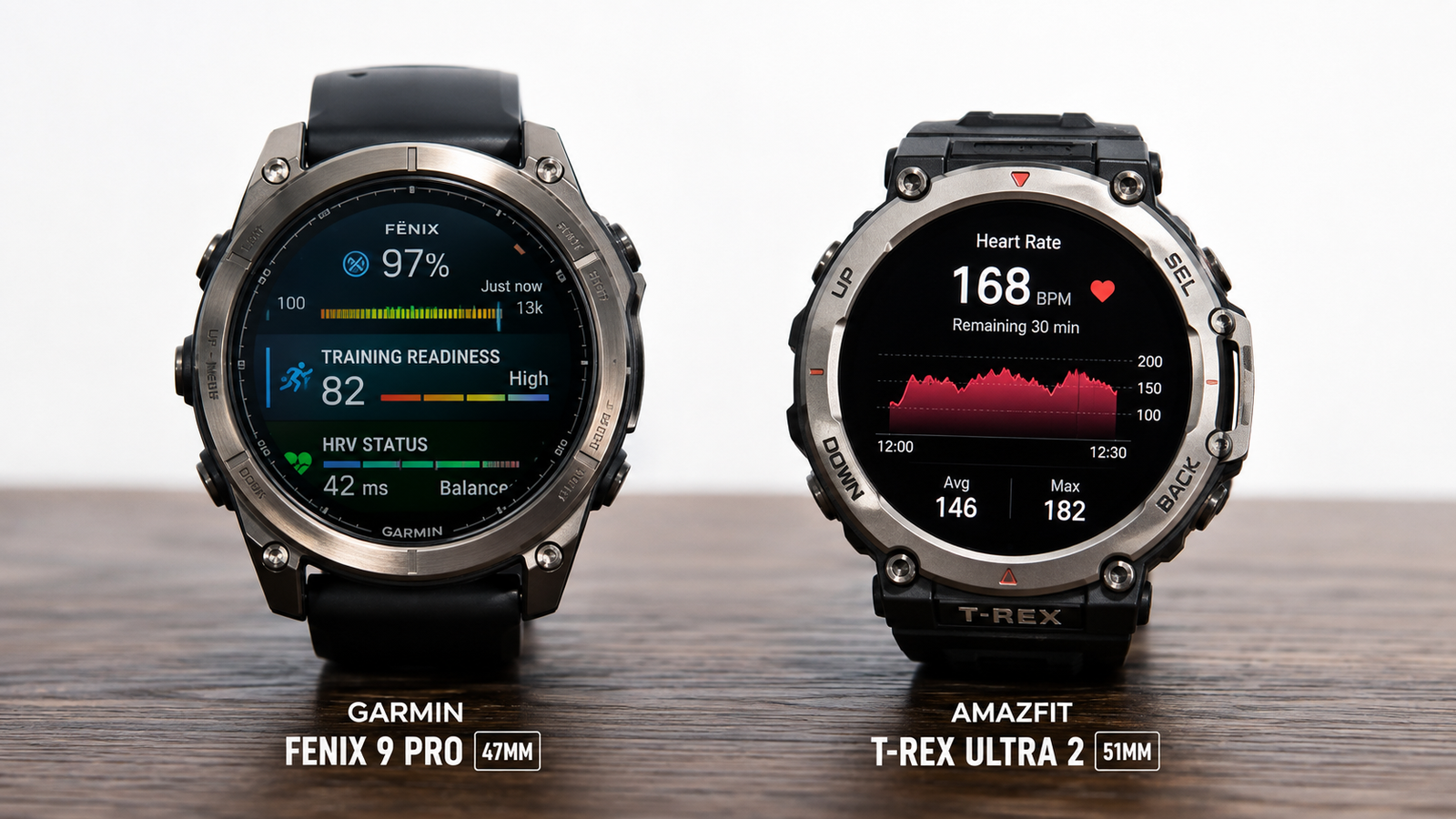
Garmin Fenix 9 Pro vs Amazfit T-Rex Ultra 2 (2026): Is the $750 Gap Worth It?
Garmin Fenix 9 Pro vs Amazfit T-Rex Ultra 2: Is the $750 Gap Worth It in 2026?
📊 12-min read ·
🏆 #1 in Adventure Watch Comparisons
Garmin just launched the fēnix 9 Pro on August 25, 2026, and the pricing
puts a familiar question back on the table: do you actually need a $1,099+ adventure watch,
or does the $549.99 Amazfit T-Rex Ultra 2 get you 90% of the way there?
We’ve spent the last few days pulling apart the official spec sheets,
hands-on impressions, and real-user feedback from both sides. In this no-fluff comparison,
we break down exactly what that $750 price gap buys you — and who should save their money.
*We earn a small commission if you buy through our links — at no extra cost to you.
Quick Comparison: Specs at a Glance
| Feature | Garmin fēnix 9 Pro (47mm) | Garmin fēnix 9 Pro Solar (51mm, inReach) | Amazfit T-Rex Ultra 2 (51mm) |
|---|---|---|---|
| Price | $1,099.99 | $1,299.99 | $549.99 |
| Case material | Full Titanium | Full Titanium | Titanium bezel/back, polymer body |
| Display | AMOLED, 3,000 nits | MIP Solar (Power Sapphire) | AMOLED, 3,000 nits |
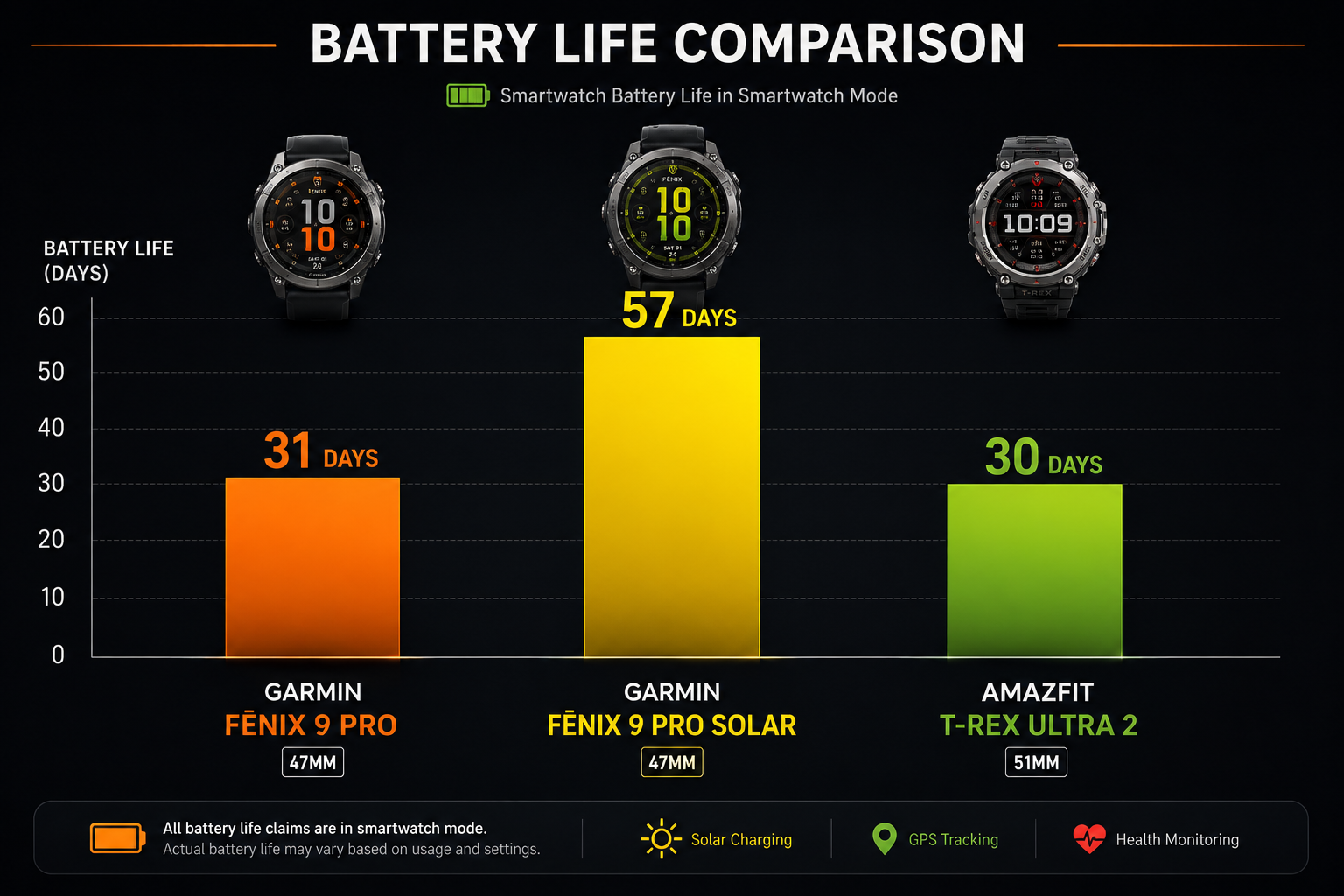
| Battery (typical use) | Up to 31 days | Up to 57 days | Up to 30 days |
| GPS | Multi-band | Multi-band | Dual-band, 6-satellite |
| Offline maps | Yes | Yes | Yes, preloaded global |
| Storage | 64GB | 64GB | 64GB |
| Satellite messaging | No (add $100) | Yes, built-in | No |
| Dive rating | 40m | 40m | 40m |
| Flashlight | LED + green night mode | LED + green night mode | Dual-color LED |
💡 Both companies have updated storage specs since earlier leaks — Garmin’s fēnix 9 line ships with 64GB across the board, matching the T-Rex Ultra 2. Reported dive ratings for the T-Rex Ultra 2 range from 40m to 45m depending on the source; we’ll update this once Amazfit’s official spec page is confirmed.
Why the Fenix 9 Lineup Gets Confusing Fast
Before comparing against Amazfit, it’s worth untangling Garmin’s own lineup.
The base fēnix 9 starts at $999.99 for the 43mm and 47mm sizes and
comes only with an AMOLED display. Step up to fēnix 9 Pro and the
starting price is $1,099.99 — but that gets you the same AMOLED panel, just with
Garmin’s newer mapping engine and expanded training features.
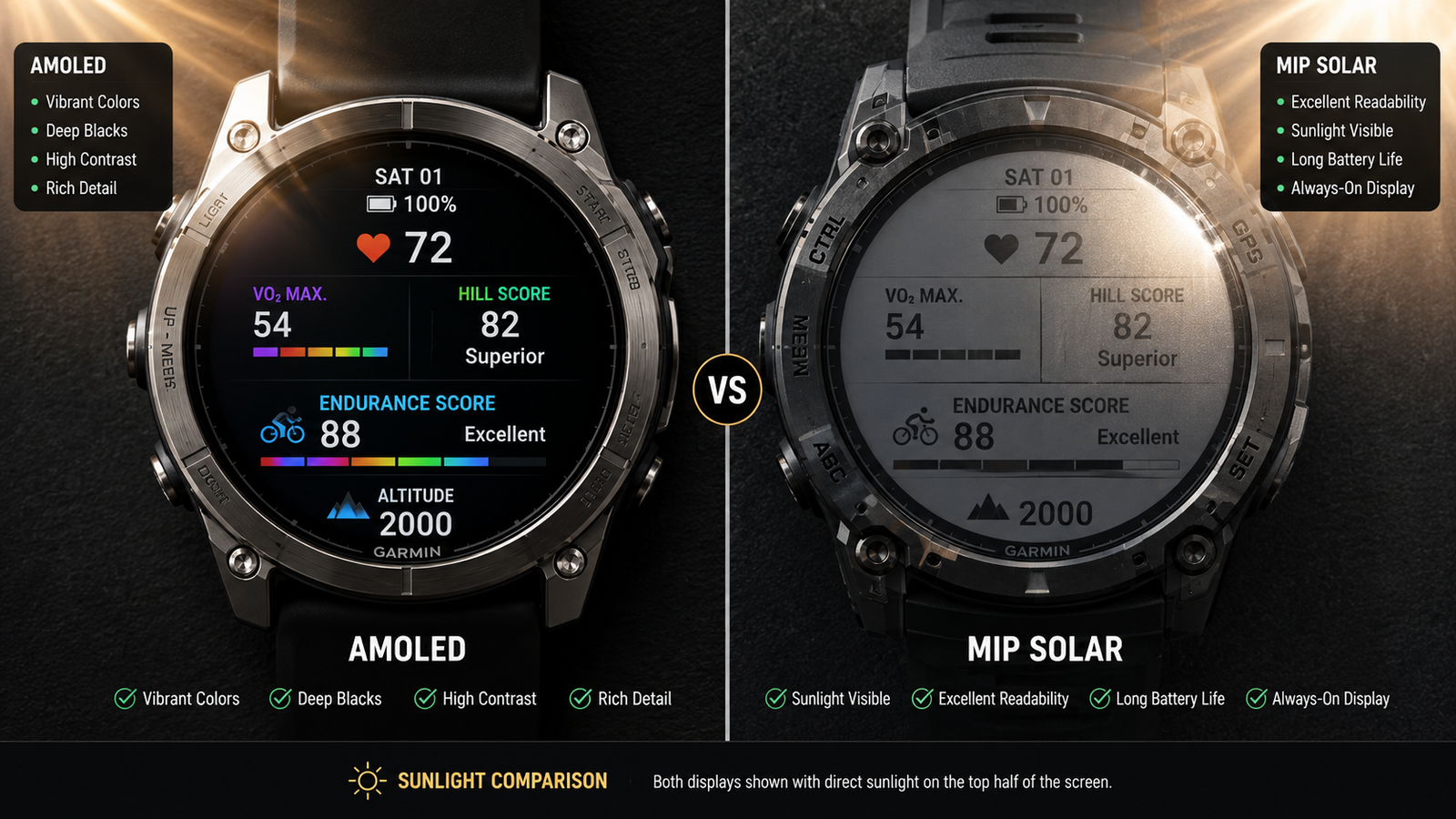
Where it gets genuinely useful is the Pro Solar option, available only
at 47mm and 51mm. It swaps the bright AMOLED panel for a MIP display with solar charging,
trading peak screen brightness for battery life that stretches to
34 days at 47mm and 57 days at 51mm in typical use — and reportedly
well beyond that in power-saving modes.
👉 The real decision inside Garmin’s own range isn’t “Fenix 9 vs Fenix 9 Pro” —
it’s AMOLED vs Solar display, and inReach yes or no.
📺 Watch our full hands-on comparison on YouTube
Where the Amazfit Closes the Gap
The T-Rex Ultra 2 was built specifically to undercut watches exactly like this.
It shares more with the Fenix 9 than the price tag suggests:
- A 1.5-inch AMOLED display rated at the same 3,000-nit peak brightness
- A titanium bezel and back panel
- 40-meter dive certification
- Dual-band GPS with six-satellite positioning
- 64GB of storage with preloaded global offline maps out of the box
Independent testers who’ve logged weeks with the T-Rex Ultra 2 describe it as capable of
covering the large majority of what a Fenix does for close to half the money, while
acknowledging Garmin’s software ecosystem — training plans, coach integrations,
and third-party app support — remains more mature.
What You’re Actually Paying Garmin For
Strip away the marketing and the case for the Fenix 9 Pro comes down to three things the
Amazfit doesn’t match:
-
Satellite SOS and messaging. The T-Rex Ultra 2 has no equivalent to inReach.
If you’re regularly off-grid — multi-day backcountry trips, solo expeditions — this is the
feature that can’t be replicated with a firmware update. -
Garmin Connect’s ecosystem. Structured training plans, coach integrations,
deeper historical data, and broader third-party sensor support are all more developed on
Garmin’s side. -
Extreme battery ceilings. The Pro Solar’s 57-day rating (and multi-hundred-day
expedition mode) is in a different league from anything Amazfit currently ships.
What you’re not paying extra for, based on the spec sheets, is materially better
core hardware. Screen brightness is identical on paper. Both watches dive-rate to a similar
depth. Both include offline maps, 64GB of storage, and a titanium build in some form.
Total Cost of Ownership (3-Year View)
| Expense (3 years) | Garmin Fenix 9 Pro Solar + inReach | Amazfit T-Rex Ultra 2 |
|---|---|---|
| Upfront purchase | $1,299.99 | $549.99 |
| inReach subscription (Safety Freedom, $14.95/mo) | $538.20 | $0 |
| Total 3-year cost | $1,838.19 | $549.99 |
| 💰 Difference | You pay ~$1,288 MORE for Garmin over 3 years | |
⚠️ This uses Garmin’s cheapest inReach plan (Safety Freedom, $14.95/mo) run year-round. Higher-tier Recreation ($34.95/mo) or Expedition ($64.95/mo) plans widen the gap further; suspending the plan seasonally narrows it.
Who Should Buy Which?
✅ Get the Fenix 9 Pro if:
- You need satellite SOS for genuine off-grid trips
- You’re already inside Garmin’s ecosystem (old Fenix, Forerunner, or Instinct)
- You want the longest battery ceiling available in this class
✅ Get the T-Rex Ultra 2 if:
- You want a rugged adventure watch under $600
- You don’t need built-in satellite messaging
- Your main activities are hiking, running, and general outdoor use
📊 Which one would YOU choose?
Frequently Asked Questions
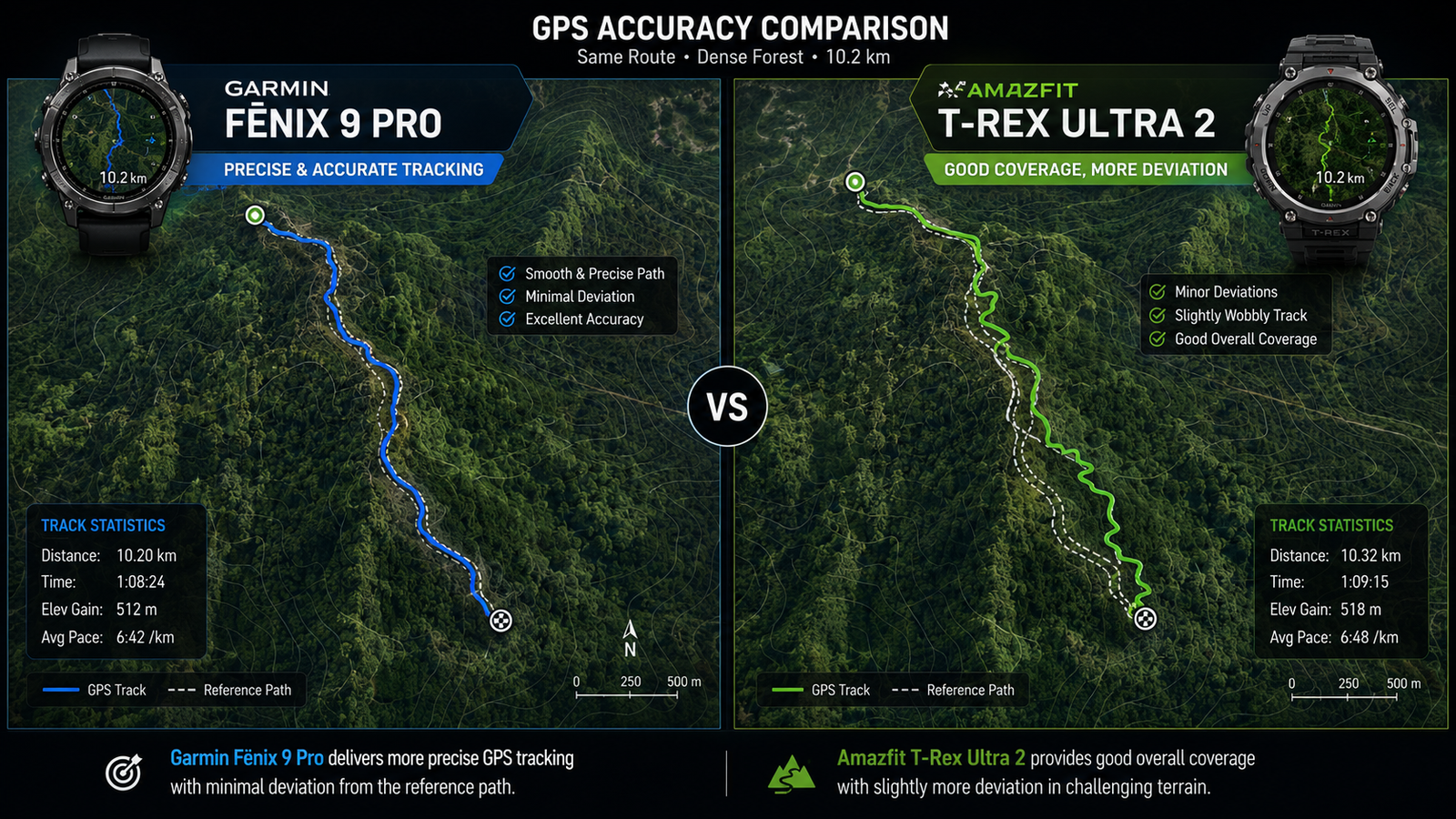
On open terrain, testing suggests the two are close. Under heavy tree cover on technical trails,
Garmin’s GPS still has a slight edge according to independent reviewers, though the gap has narrowed
with recent firmware updates.
Yes — inReach connectivity requires an active satellite subscription on top of the $100 hardware
add-on. Garmin’s cheapest plan, Safety Freedom, is $14.95/month (pausable off-season);
Recreation and Expedition tiers cost more and add unlimited messaging and in-device weather.
At that price, Garmin sells both an AMOLED fēnix 9 Pro and a Solar fēnix 9 Pro (47mm).
The AMOLED version has a brighter, more colorful screen; the Solar version trades that for
roughly 34 days of battery life versus 31.
Not quite. The T-Rex Ultra 2 uses a fiber-reinforced polymer main case with a titanium bezel,
buttons, and back panel, while Garmin’s fēnix 9 line uses a full titanium case
across the board.
The Verdict: Which One Wins?
If you need satellite SOS or you’re deep in Garmin’s training ecosystem already,
the Fenix 9 Pro earns its price. For nearly everyone else doing hiking, trail running,
or general outdoor use, the T-Rex Ultra 2 delivers most of the same experience for well under
half the cost — and that gap widens further once you factor in inReach subscription costs over time.
📌 You might also like
tinyhavenco.com is reader-supported. Some links on this page are affiliate links
(including Amazon). If you click through and make a purchase, we may earn a commission
at no additional cost to you. We only recommend products we truly believe in.
📅 Last updated: August 30, 2026 ·
✍️ Written by: Review Markets Team