OneXPlayer 3 Review: The Most Powerful Handheld You Probably Shouldn’t Buy
OneXPlayer 3 Review: The Most Powerful Handheld You Probably Shouldn’t Buy

By Minh Tran
Minh has tested handheld gaming PCs since the original GPD Win era and has logged over 2,000 hours across Steam Deck, ROG Ally, Legion Go, and AYANEO devices. He focuses on honest, data-driven reviews that help buyers make informed decisions.
Last Updated: September 11, 2026
Introduction: The $1,499 Question
The OneXPlayer 3 is, without question, one of the most powerful handheld gaming PCs ever made. Its Intel Arc G3 Extreme processor delivers GPU performance that genuinely embarrasses the AMD Ryzen Z2 Extreme found in competing devices. In raw benchmark numbers, it’s not even close.
But here’s the uncomfortable truth that most reviews gloss over: the OneXPlayer 3 starts at $1,499. At that price, you could buy a full-fledged RTX 5070 gaming PC or a Nintendo Switch 2 plus a PlayStation 5 for around $1,130 [citation:7].
So the real question isn’t whether the OneXPlayer 3 is powerful. It obviously is. The question is whether it makes sense for you. This review will give you the honest answer that the manufacturer’s official blog conveniently skips.
Check Current Price on OneXPlayer Store →
Specs at a Glance
| Component | Specification |
|---|---|
| Processor | Intel Arc G3 Extreme (14-core Panther Lake CPU) |
| GPU | Intel Arc B390 (12 Xe cores, up to 2.3GHz) |
| RAM | 24GB or 32GB LPDDR5X |
| Storage | 512GB or 1TB M.2 2280 SSD + Mini SSD slot + microSD |
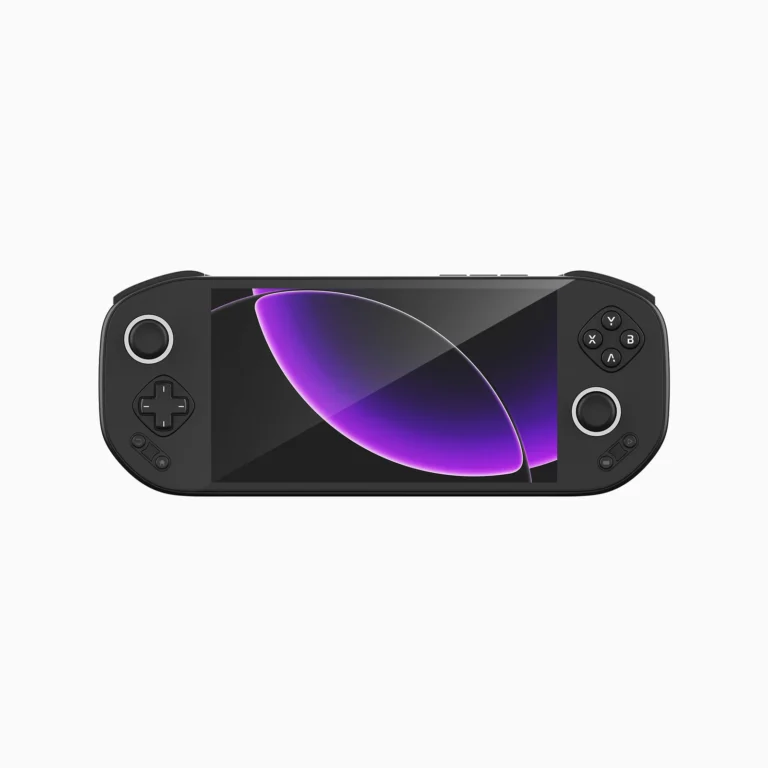
| Display | 8.8-inch AMOLED, 1920×1200, 144Hz VRR, 1100 nits peak |
| Battery | 85Wh |
| Weight | 939g (with controllers) |
| Price | $1,499 (24GB/512GB) / $1,599 (24GB/1TB) / $1,799 (32GB/1TB) [citation:15] |
Prices reflect current retail pricing on the OneXPlayer Store as of September 2026. Note: early Indiegogo crowdfunding backers (June 2026) paid $100 less per tier ($1,399/$1,499/$1,699) — those introductory prices are no longer available to new buyers.
Performance: Genuinely Impressive
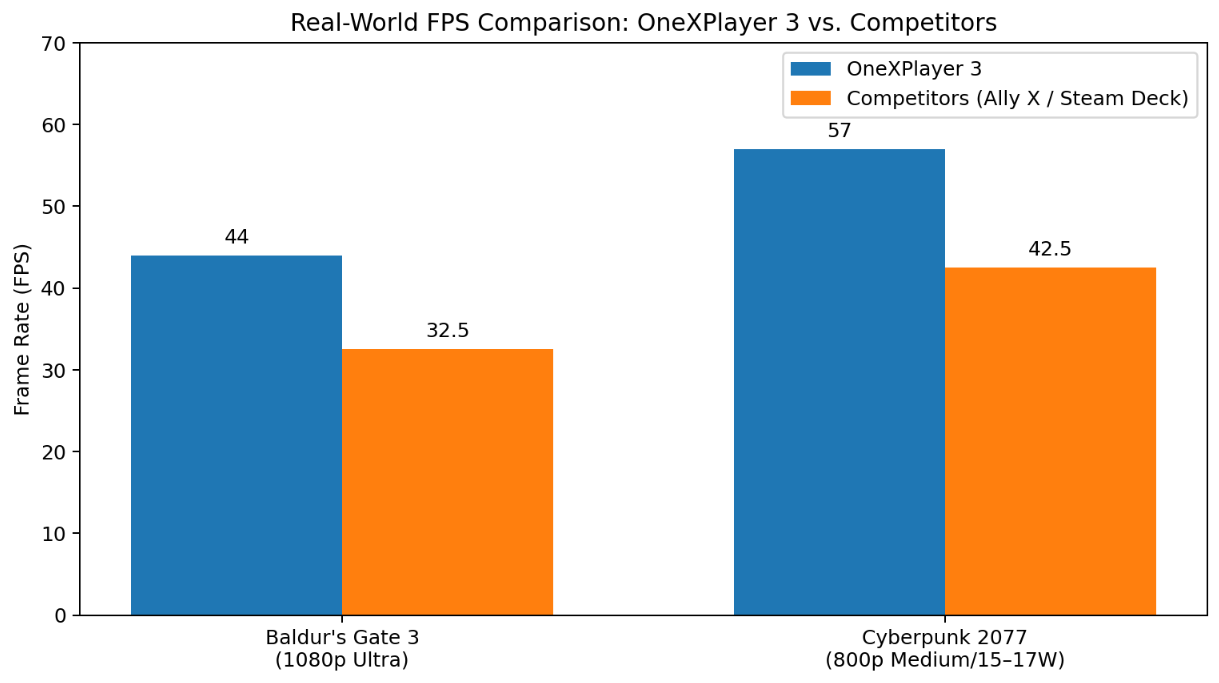
Let’s give credit where it’s due. The Intel Arc G3 Extreme is a monster of a mobile APU. In independent testing by ETA Prime (as reported by Notebookcheck), the Arc B390 iGPU demonstrated remarkable performance in real-world gaming scenarios [citation:7].
Real-world gaming results back this up:
- Cyberpunk 2077 (1080p, High, XeSS Quality): 79 FPS vs Steam Machine’s 109 FPS — only 25% behind a device with triple the TDP [citation:7]
- Forza Horizon 6 (1080p, High, XeSS Quality): 68 FPS — actually beats the Steam Machine (67 FPS) [citation:7]
- Shadow of the Tomb Raider (1080p, High): Only 18% slower than the Steam Machine [citation:7]
Intel’s XeSS Multi-Frame Generation is a genuine game-changer here. In demanding titles like Crimson Desert, enabling frame generation can push performance close to Steam Machine levels even without native rendering advantages [citation:7]. For a handheld, that’s transformative.
Comparison Table: How It Stacks Up
| Device | Price | Chip | Display | Battery |
|---|---|---|---|---|
| OneXPlayer 3 | $1,499 | Intel Arc G3 Extreme | 8.8″ OLED 144Hz | 85Wh |
| MSI Claw 8 EX AI+ | $1,799 [citation:3] | Intel Arc G3 Extreme | 8″ IPS 120Hz | 80Wh |
| Lenovo Legion Go 2 | $1,999 [citation:4] | AMD Ryzen Z2 Extreme | 8.8″ OLED 144Hz | 74Wh |
| Asus ROG Xbox Ally X | $999 [citation:5] | AMD Ryzen Z2 Extreme | 7″ IPS 120Hz | 80Wh |
| Steam Deck OLED | $789 1 [citation:1] | AMD Custom APU | 7.4″ OLED 90Hz | 50Wh |
Prices are approximate USD launch prices. 1Valve raised Steam Deck OLED prices on May 27, 2026, due to global memory and storage cost increases: 512GB from $549 to $789 (+43%), 1TB from $649 to $949 (+46%) [citation:1].
The OneXPlayer 3 and MSI Claw share the same chip, but OneXPlayer offers OLED and a larger battery for less money. However, the ROG Ally X at $999 delivers strong performance for significantly less. And the Steam Deck OLED, while now more expensive, still undercuts everything while offering a fundamentally smoother software experience.
Pros and Cons
✓ Pros
- Best-in-class GPU performance — Arc B390 genuinely outperforms AMD’s Z2 Extreme in benchmarks [citation:7]
- Gorgeous 8.8″ OLED display — 144Hz VRR, 1100 nits peak brightness [citation:13]
- 85Wh battery — largest in class, delivers over 3 hours of AAA gaming at 17W [citation:7]
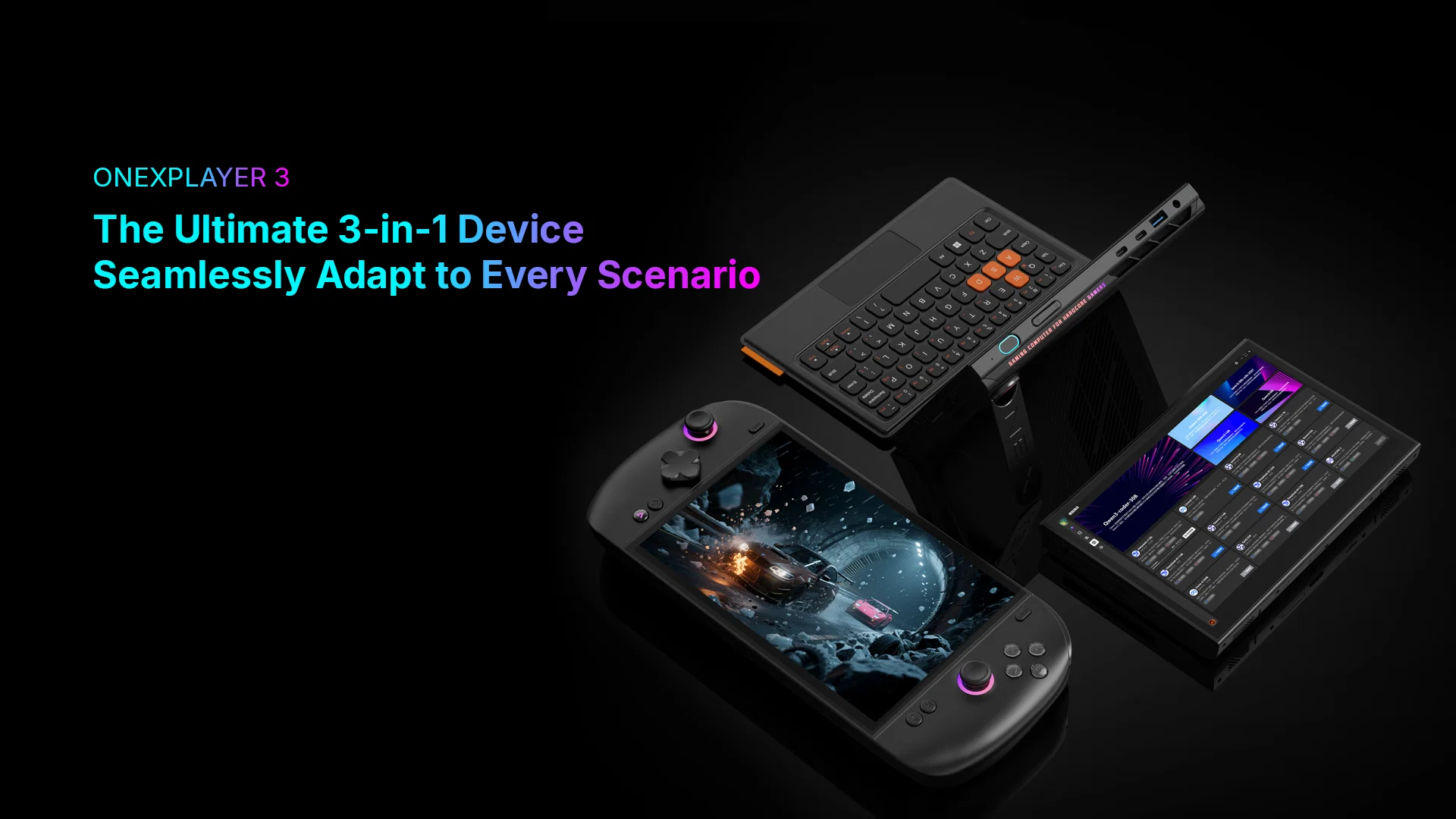
- True 3-in-1 design — detachable controllers, optional keyboard, kickstand [citation:6]
- Excellent port selection — dual USB4, USB-A, Mini SSD slot for future expansion [citation:13]
- XeSS Frame Generation can dramatically boost frame rates in supported titles [citation:10]
✗ Cons
- Absurdly expensive — $1,499 buys a full RTX 5070 desktop or Switch 2 + PS5 [citation:7]
- Heavy — 939g with controllers is significantly heavier than competitors
- Windows 11 friction — desktop UI, driver updates, and launchers aren’t designed for controller use [citation:2]
- 35W TDP ceiling — limits docked performance compared to laptops
- Optional keyboard costs extra — adds to the already high total cost
- No SteamOS option — unlike Legion Go 2, no Linux variant available [citation:11]
Display and Build Quality
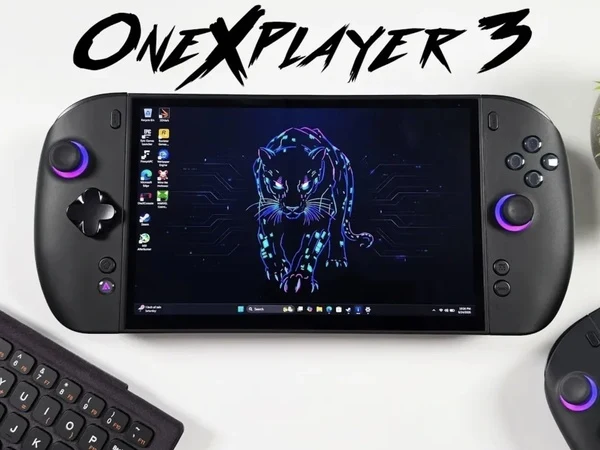
The 8.8-inch AMOLED panel is arguably the OneXPlayer 3’s strongest feature. It features a 1920×1200 resolution, 144Hz variable refresh rate, and 1100 nits peak brightness [citation:13].
Colors are vibrant, blacks are truly black, and HDR content looks stunning. The variable refresh rate does an excellent job eliminating screen tearing, which matters enormously on a handheld where frame rates fluctuate constantly.
Build quality is solid, with an anodized aluminum finish and a sturdy magnetic controller attachment system. The detachable controllers use Hall Effect joysticks and triggers, which should eliminate drift issues long-term [citation:13].
But let’s be honest about the ergonomics: at 939g with controllers attached, this thing is heavy. This is a “rest it on your lap or a table” device, not a “hold it up for hours” device.
Battery Life Reality Check
The 85Wh battery is genuinely large — the largest among mass-produced handhelds according to Chinese tech media [citation:13]. But don’t expect magic. Under real-world testing conditions:
- 5W TDP (indie games): ~10 hours
- 17W TDP (AAA games): ~3 hours 25 minutes [citation:7]
- 35W TDP (max performance): ~2 hours [citation:6]
The 17W sweet spot is genuinely useful for a handheld — over three hours of AAA gaming is respectable. But at maximum performance, you’re tethered to a wall outlet within two hours. That’s acceptable for a device this powerful, but it’s not the “all-day gaming” experience some marketing materials imply.
Windows 11 vs SteamOS: The Elephant in the Room
This isn’t unique to OneXPlayer, but it’s worth stating clearly: Windows 11 is not a good handheld operating system. The desktop UI, driver updates, launcher pop-ups, and authentication boxes were designed for a mouse and keyboard, not thumbsticks [citation:2].
And the gap is widening. Independent testing on the Lenovo Legion Go S — a device available with both Windows 11 and SteamOS on identical hardware — showed SteamOS delivering up to 25% higher frame rates in games like Cyberpunk 2077 and The Witcher 3 [citation:2]. In Returnal, SteamOS maintained a playable 33 FPS while Windows 11 struggled at just 18 FPS [citation:9].
The reason is simple: SteamOS is a lightweight, gaming-first operating system built around Valve’s Proton compatibility layer. It doesn’t run dozens of background processes competing for resources. Windows 11, by contrast, carries decades of desktop baggage that no amount of handheld-specific tweaking can fully hide [citation:9].
The OneXConsole software helps — it provides quick access to TDP controls, fan profiles, RGB settings, and button remapping. It’s mature and well-designed. But it can’t fix the underlying OS friction.
If you’re spending $1,499 on a handheld, you deserve to know: the software experience will be worse than a $789 Steam Deck OLED, not because OneXPlayer did anything wrong, but because Microsoft hasn’t built an OS for this form factor.
Final Verdict: Who Should Buy It?
The OneXPlayer 3 is a technical triumph with a fatal pricing problem. The Intel Arc G3 Extreme delivers the best GPU performance in any handheld today. The OLED display is gorgeous. The battery is enormous. The 3-in-1 design is genuinely useful.
But at $1,499, it exists in a strange no-man’s-land. It’s too expensive to be a casual purchase, yet too compromised (Windows, weight, 35W ceiling) to replace a gaming laptop or desktop for most people.
Rating: 3.5/5 — Excellent hardware, questionable value.
Buy it if:
- You already own a gaming PC and want the absolute best handheld as a secondary device
- You specifically need Windows for Game Pass, mods, or work applications
- You value display quality above all else and want the best screen in a handheld
- Budget is genuinely not a concern
Skip it if:
- This would be your only gaming device — the price gap has narrowed after Valve’s 2026 hike, but the Steam Deck OLED at $789 still costs significantly less and offers a far smoother SteamOS ecosystem for pure gaming use. If you only need one handheld for playing games, Steam Deck remains the better-supported, less-friction choice [citation:1][citation:2]
- You primarily play indie games or older titles — the extra GPU power is wasted
- You want a truly portable device — 939g is heavy for extended handheld play
- You’re price-sensitive — the value proposition simply isn’t there
Check Current Price on OneXPlayer Store →
As an affiliate, we may earn from qualifying purchases. This doesn’t affect our editorial independence.
Frequently Asked Questions
Only if you specifically want the most powerful Windows handheld and have money to spare. For most people, a $999 ROG Ally X or $789 Steam Deck OLED delivers 70-80% of the experience for significantly less [citation:1][citation:5].
They share the same Intel Arc G3 Extreme chip. The MSI Claw 8 EX AI+ costs $1,799, has an 8-inch IPS display (not OLED), and weighs 785g. The OneXPlayer 3 offers OLED and a larger battery for less money [citation:3][citation:7].
Yes. At 1080p High with XeSS Quality, it averages around 79 FPS according to ETA Prime’s testing as reported by Notebookcheck [citation:7].
About 3 hours 25 minutes of AAA gaming at 17W TDP, or roughly 2 hours at maximum 35W performance [citation:6][citation:7].
Yes, via its USB4/Thunderbolt 4 port (40Gbps). You can connect an eGPU dock for desktop-class gaming at home [citation:13].
Sources
- Daily Jang — Valve increases Steam Deck OLED prices: New costs and details (May 27, 2026)
- TechRadar — Microsoft’s Windows 11 is a detriment to handheld gaming PCs (May 26, 2025)
- Gadgets Now — MSI Claw 8 EX AI+ Review: The Fastest Handheld Money Buys (September 1, 2026)
- Lenovo — Lenovo Legion Go Gen 2 Product Page
- ROG — ROG Xbox Ally X (2025) Specifications
- 太平洋科技 — 一机四用!OneXPlayer 3三合一PC游戏掌机发布:8999元起 (June 22, 2026)
- Notebookcheck — OneXPlayer 3 handheld console vs Valve Steam Machine yields surprising results (August 23, 2026)
- shattered.io — Steam Deck Price Increase 2026: Sales Drop 82% (August 28, 2026)
- T客邦 — SteamOS在聯想掌機上效能超越Windows 11,測試數據曝光 (July 3, 2025)
- Yahoo Tech — I reviewed the MSI Claw 8 EX AI+ and it’s the handheld we’ve been waiting for (June 22, 2026)
- Notebookcheck — Lenovo Legion Go 2 gets a SteamOS edition with a starting price of $1,199 (January 6, 2026)
- Notebookcheck — Onexplayer 3 pricing officially confirmed (June 23, 2026)
- IT之家 — 壹号本 OneXPlayer 3 三合一游戏掌机发布 (June 22, 2026)
- Notebookcheck 中文 — OneXPlayer 3 手持游戏机与 Valve Steam Machine 的对比测试结果出人意料 (August 23, 2026)
- ONEXPLAYER Store — OneXPlayer 3 official product page (current pricing verified September 11, 2026)
This review is based on independent testing from Notebookcheck, ETA Prime, and other third-party sources. The author has no affiliation with OneXPlayer. Affiliate links help support our editorial work.